


Parts of us really want to tell you so here it goes: “we have a new website1, go check it out2!”
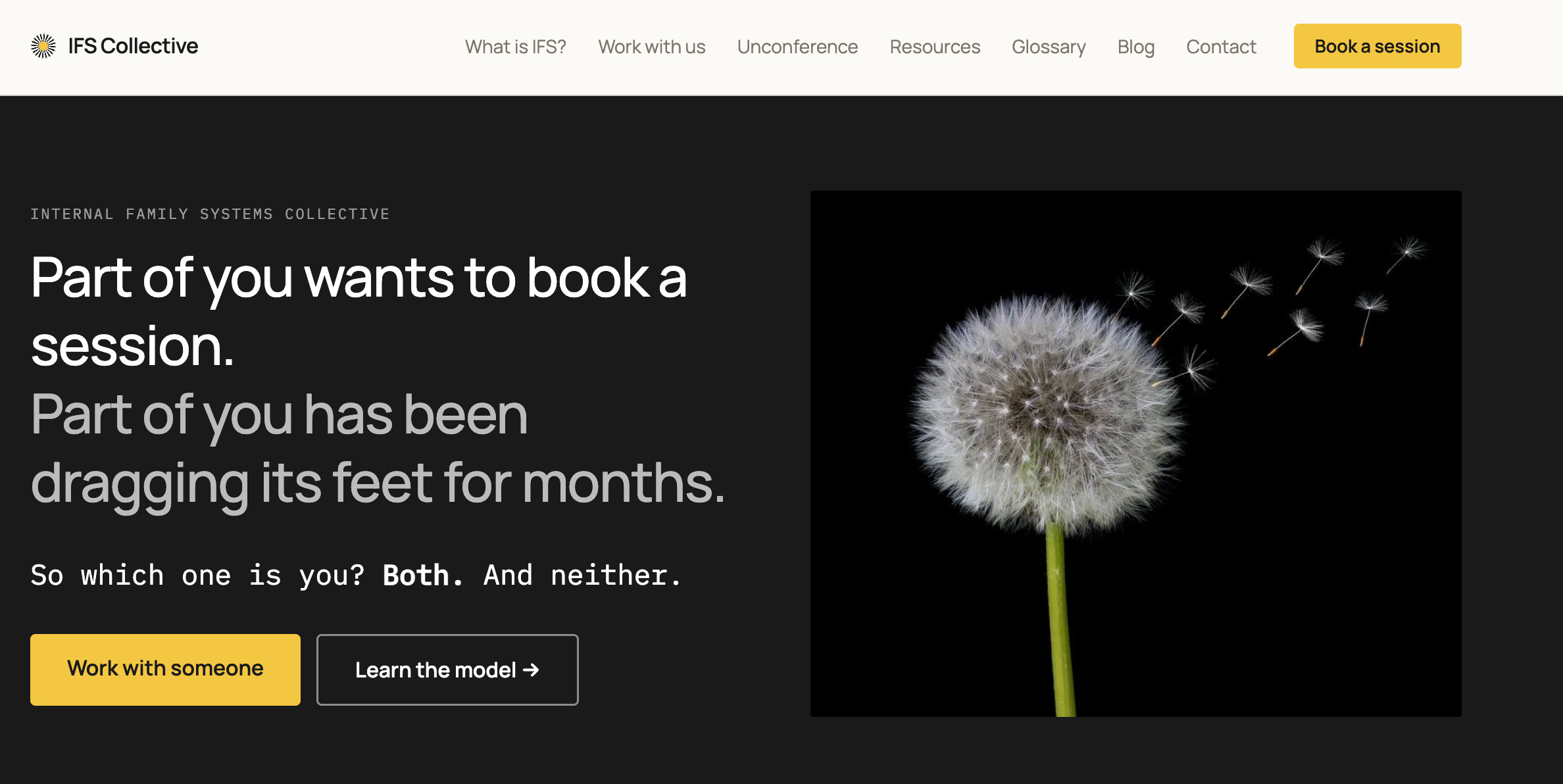
On the other hand, we suspect you do not care about the website as much as we do, the same way friends often don’t care as much as we do about our 200 holiday photos, so here's the interesting (or so we hope) bit: we realized something important was missing from our previous page3: we never shared what this "parts work" thing (or IFS) is for us, and how we approach it.
Also: our next online Parts Work Unconference is November 21st. More on that at the end!
Pau: before I even started training, discovering IFS felt like a natural extension of everything I was already doing: suddenly I could get in contact with what was coming up for me in meditation and go beyond just ‘staying with it’ (“omg this ‘thing’ talks back!”).
Alex: the way I facilitated groups and held shared spaces matched how Self (energy) enriches a space where parts can feel safe and heard, making space for parts, giving the more silent ones a way to express themselves, and showing the loud ones that the quiet ones have something to contribute. It felt natural, I knew the territory. And: “oh wow, I did not know you could get this sort of material from inside without psychedelics!”.
For both of us, speaking for parts meant that arguments turned from “you hurt me” to “a part of me feels hurt”, leaving a lot more room to hold things together in conflicts; speaking for parts and knowing that the other person has parts can helps us not treat what we share or hear as the single truth about ourselves or the other, and often enables curiosity in dialogue. We both knew it worked (well beyond the therapy room), and this is the first time we've really tried to write down what IFS is, why we like it, why we built a practice and partly a life around it.
The result is an expanded “what is IFS” on our site, and this is a shorter version of it. Even if you know IFS, we hope you might enjoy reading how we hold it:
Try it first
You're reading the IFS Collective Substack, so maybe you already know what IFS is, and have already tried it. Still, we still wanted to give you a quick taster. A glimpse, as Loch Kelly would put it.
This takes around 2 minutes. You can do it right now, nobody watching, no one hearing anything. Don’t take our word for anything (in ‘our book’, the felt sense always goes further than words).
Bring to mind something small you’re in two minds about. Nothing too heavy for now: an unanswered message, a habit you keep meaning to change, something you keep telling yourself “shouldn't be a big deal” (but is)
You now have at least two sides, or at least two opinions. Let’s say it is the one that says “we should work out in the morning”. Let’s call it a part (of you, because it is).
Where do you sense this? Anywhere in or around your body? Is it behind your head, around it, in your chest, in your left little toe? Does it come as a sensation, an urge, an image, a tone of voice? It doesn’t have to be visual.
Now, before doing anything with it, notice how you feel towards it. That’s the whole question. Not what it is. Not how to fix it. Not if it is right, or whether it should be there. Just what your attitude to it is, right now.
This is where it gets interesting.
If the answer is anything but gentle open curiosity and care, if it is something like irritation, or urgency, or ugh, this again... we consider that to be another part, and it’s welcome too. This is where it gets interestingSee whether it would step back a little, so that you can listen to the first one. If not, switch and stay with this one instead (this now takes more than two minutes; there's a reason sessions don't last two minutes……)
And if at some point you notice you’re simply… curious towards the first one or any other part that came up, without needing it to change?
The curiosity you felt (or glimpsed, or sensed as a possibility without quite reaching it) isn't another part. In IFS it’s called Self, or at least having (enough) Self energy, and the claim of the model is that it’s always there, undamaged, underneath whatever is currently driving. It doesn’t have to be built or earned. It just needs the parts in front of it to trust it enough to make room. It is what allows parts to to get unstuck, to release what they carry, to work with the rest of the system.

Self is the piece of the model we’re least confident describing, and most writing we know about it gets vague fast, or make statements we do not feel confident about. The way we feel it in practice is not that flashy or glamorous: you’re annoyed, you notice you’re annoyed, and there’s still enough room in the system that you can slow down, show up differently, or say aloud “I am getting a bit worked up here, give me a moment”.
Everything after this is the craft of building trusting relationships with parts, allowing them to give enough space that Self energy can “flow” or “shine”4; helping them to feel safe enough to step back, hearing what they’ve been holding, and helping them release (without pressure), and to become more aware of the present.
What we think it is
“There are no bad parts. There are parts stuck in old roles and realities.”
IFS starts from something you probably always knew and were encouraged to grow out of: you are not one single thing. You’re a crowd. There’s a part of you that pushes, a part that hides, a part that keeps the peace, and a part that tries to figure it all out at 4am.5 You probably show different aspects of yourself to close friends, colleagues, a life partner, family members, the cashier at the supermarket.
IFS says that isn’t a symptom. It’s how minds are built. Then it says something more surprising: every one of those parts is trying to help you. Even the cruel ones. Especially the ones that look like sabotage. They took on their roles a long time ago, usually when you were small and something was too much to bear, and they’ve been doing them ever since, often long past the point where it made sense, and often without noticing that the situation around them has changed.
There are no bad parts. There are parts stuck in old roles and realities.
Putting it all together
We rebuilt ifs-collective.com. Three things we’re especially proud of:
What is IFS?
The long version of this post, in three layers: two minutes, five minutes, and one for the thorough. Plus an FAQ answering what people actually ask us, including the slightly awkward ones.
Glossary
Updated and more integrated with the rest of the site. Around 60 cross-linked terms, from unblending to spiritual bypassing to the four immeasurables. It exists because we kept using words like “unblending” in articles and then feeling like we had to spend a paragraph explaining them.
It isn’t authoritative: we’re not the IFS Institute, we’re the people who run events with no keynote speakers and have published an article about the sock of destiny. Where our usage drifts from the canon, or where we just have opinions, we try say so in the entry.
Resources
Our favorite IFS resources and beyond. Everything here has been used by at least one of us, and each entry says something specific about why, including where we think a thing is overrated or has limitations. Where we haven't read it, we've left it out rather than padding the list.
Before you go
If you want to explore more about What is IFS, meet us and a whole bunch of others exploring these and other interesting questions, come to our next online Parts Work Unconference happening on Nov 21st. Feel free to spread the word or the flyer of the event: the more the merrier!

Finally, if you’d rather have someone alongside you to practice, sessions are here: English with either of us, Italian with Alex, Polish with Pau (if you ask nicely).
After weeks of designing and crafting content (hats off to Alex for the massive amounts of work he put into this), we finally feel that the website talks like we do, about the things we actually do.
It has been an interesting dance between Pau’s minimalist parts, Alex’s “let’s share everything we find useful or interesting, let’s add disclaimers and comments and explanations” parts, and we think we’ve managed to strike a happy balance.
At least we are happy about it.
We would love you to check it out and send us feedback whether that’s a thumbs up or you find something on there that reads confusing or wrong.
OK, fine, SEVERAL things were missing. Only a few important ones.
did we mention the “piece of the model we are the least confident describing”?
and a chorus of other parts annoyed about it including “will you please shut up and let us sleep?”
Alex and Pau!! I’m looking forward to the next Unconference! See you there!
Congratulations on your newly updated website!